
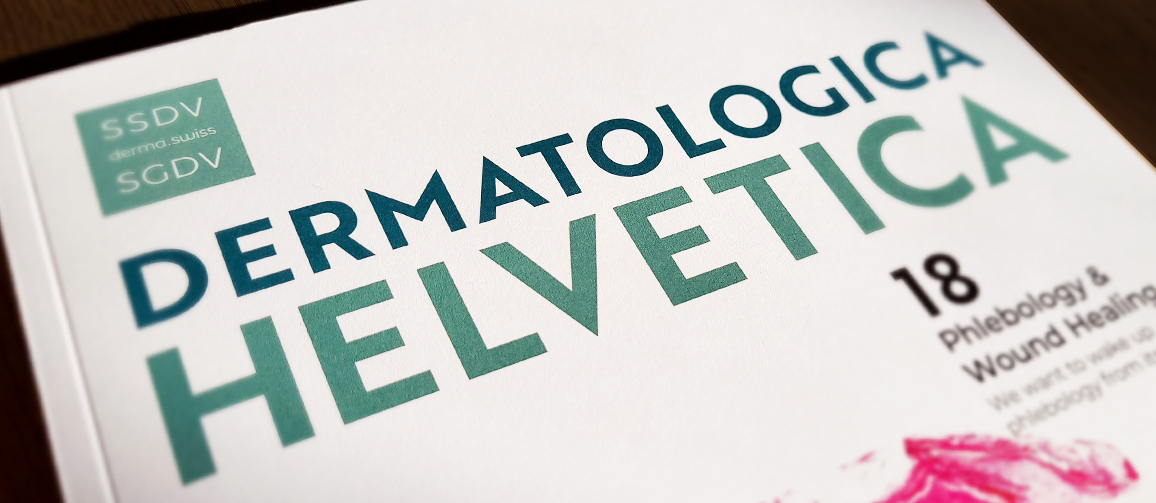
Aims and scope of Dermatologica Helvetica
Dermatologica Helvetica is a hybrid access, specialized journal for dermatologists in Switzerland published by the Swiss Society of Dermatology and Venereology (SSDV). The journal is aimed at dermatologists and all scientists interested in dermatology. Dermatologica Helvetica has been published by the SSDV in the new format since 2022 (
The Editors-in-Chief are Prof. Dr. Daniel Hohl and Prof. Dr. Jürg Hafner. Daniel Hohl is Past President (2019-2023) of the SSDV and has worked in research at the University Hospital of Vaud (CHUV) for many years. Jürg Hafner is a Senior Physician at the Department of Dermatology at the University Hospital Zurich (USZ) and was President of the SSDV from 2011 to 2015.
The Editorial Board of Dermatologica Helvetica comprises experienced dermatologists who have special expertise in their field. They ensure that every issue contains the latest scientific information.
Print ISSN: 1420-2360
Online ISSN: 1420-2360
Is the journal Dermatologica Helvetica open to the public?
Dermatologica Helvetica is not open to the public but is freely accessible to all SSDV members (Become a member of the SSDV) and to all subscribers to Dermatologica Helvetica (Become a subscriber to Dermatologica Helvetica).
Are there any publication fees for authors?
The publication of a scientific article does not involve any fees for the authors.
Where can articles for Dermatologica Helvetica be submitted?
All articles can be submitted to redaktion@derma.ch.
Where are the Dermatololgica Helvetica articles archived?
All articles are archived in the secure member/subscriber area of Dermatologica Helvetica.
Who can submit an article in Dermatologica Helvetica?
Any physician with a board certification in dermatology and venerology, dermatologists in training, and other scientists may submit an article for publication. Most articles are submitted on request by the Editorial Board and reviewed by one of the Editors-in-Chief or the Editorial Staff.
What kind of articles can be submitted?
General criteria for submitted articles
It is permitted to publish in Dermatologica Helvetica modified versions of articles already published in another journal, as long as this is compatible with the content of the issue. The author should indicate this at the end of the article, together with the name of the journal in which the article was previously published.
Submitted articles must be written by the authors indicated and may not contain copies of previously published work by other authors without their permission.
Two kinds of articles can be submitted to Dermatologica Helvetica:
- Focus article
Submitted Focus articles must be relevant to the Focus topic. Each issue of Dermatologica Helvetica is dedicated to a Focus topic related to the Dermatology Working Groups or other important and current topics in dermatology.
- Case Report
Case reports are independent of the focus topic and can therefore be submitted at any time.
Submitted case reports will be collected and published as soon as possible.
Are the articles in Dermatologica Helvetica peer-reviewed?
- Focus articles
All Focus articles submitted by physicians in training must be peer-reviewed by a specialist in dermatology and venerology before submission to Dermatologica Helvetica. It is the responsibility of the authors named in the article to have it reviewed by a specialist.
- Case Reports
All submitted case reports are sent by the Editorial Office of Dermatologica Helvetica to Prof. Peter Elsner (member of the Editorial Board) for review prior to publication. The Editorial Office sends the case report back to the author for revision, together with the corrections suggested by Prof. Peter Elsner. After revision by the author, the case report can be published in Dermatologica Helvetica (expected turnaround time: 2–4 weeks).
- All other articles
All other articles written by academic lecturers or professors are not peer-reviewed.
Structure of a Focus article or a Case Report
All articles should be submitted as Word documents (.doc or .docx).
All articles should be written in English. We also accept submissions in French and German, but prefer articles written in English. Dermatologica Helvetica uses British English.
Number of characters per article:
- Focus article: 4’000 – max. 10’000 characters including spaces (results in 1 to 3 printed pages)
- Case Report: 4’000 – max. 8’000 characters including spaces (results in 1 to 2 printed pages)
The number of characters per article depends on the number of illustrations to be printed. The more illustrations you want to print, the shorter the text should be.
Requested structure of your contribution
- Titre
- Lead: max. 500 characters
- Text: Continuous text with subtitles (e.g. Introduction, Materials and Methods, Results, Discussion)
- Details of the author(s): Name and academic title, name of institute or clinic and author’s photo (resolution at least 300 dpi). It is the responsibility of the corresponding author to ensure that the order in which the article’s authors and contributors are listed is correct. The corresponding author is listed first. The contact details of the corresponding author must be included with each article. Non-authors are acknowledged separately, after the authors and contributors.
- References (DOI reference, if available): Identified in the text by square brackets [1] and listed numerically in the reference list at the end of the article. Please number the references consecutively in the order in which they appear in the text.
- Illustrations (tables, figures and images): numbered and captioned. Identified in the text by round brackets (Figure 1) (Table 1).
- Possible info box (highlights/learnings) max. 500 characters (can be placed at the beginning or at the end of the article)
Illustrations (Tables, Figures, images and photos)
All copyrights for illustrations and patient consent forms for photos to be published in Dermatologica Helvetica, are the responsibility of the author and must be provided at the time of submission. Authors must take appropriate measures to protect patient privacy in their contributions.
Tables
- Should be included at the end of the manuscript
- Should be submitted in an editable format in Word (very large or complex tables may be submitted directly as an image)
- Should have a caption and a number, which is also illustrated in the text in round brackets (Table 1), (Table 2)
- Should be numbered consecutively in the order in which they appear in the text
Figures and images
- Should be submitted as a separate file
- Should have a resolution of at least 300 dpi
- Should be in the following formats: jpg, png, tiff, psd, pdf
- Should have a caption and a number, which is also cited in the text in round brackets (Figure 1), (Figures 2)
- Should be numbered consecutively in the order in which they appear in the text
Author Photo
- All articles will be published with a photo of each author
- The resolution of the photo should be at least 300 dpi
Licence
All focus articles and case reports in Dermatologica Helvetica are subject to a standard licence. They are only available to subscribers and members.
Copyright provisions, Journal’s policies on data sharing and reproducibility
Copyright
All articles published in Dermatologica Helvetica are the property of their respective authors and are protected by copyright. They may not be reproduced in any form without the written permission of the authors.
Duplicate or redundant publication
Any duplicate or redundant publication must be cited by the author at the end of the article.
Plagiarism
Any form of plagiarism is unacceptable.
Data falsification
Any form of data falsification or fabrication and misappropriation of work is unacceptable.
Conflict of interest
Authors are responsible for declaring all financial and personal relationships between themselves and others that could be perceived by others as influencing their work. Authors must explicitly indicate when potential conflicts exist.
Publication ethics and related editorial policies
Ethical oversight
All clinical trials reported in the articles must be conducted in accordance with the principles of the Declaration of Helsinki.
Authors must adhere to high ethical standards, including guidelines for consent to publish, publication on vulnerable populations, ethical conduct of research on animals, ethical conduct of research on humans, handling of confidential data, and ethical business/marketing practices.
Mechanisms for correcting, revising or retracting articles after publication
Corrections and comments on previously published articles will be published in the next print edition of Dermatologica Helvetica in the «Panorama» section.
Post-publication discussions
Open discussions about published articles will be published in the next print edition of Dermatologica Helvetica in the «Panorama» section.
Allegations of misconduct
Allegations of misconduct before and after the publication of an article can be sent by e-mail to our Editorial Office (redaktion@derma.ch). We take all allegations seriously and investigate them internally.
Complaints and appeals
Complaints about the journal, its staff, the Editorial Board or the publisher can be made by e-mail to our Editorial Office (redaktion@derma.ch). We take all complaints seriously and investigate them internally.
Business model, revenue sources and advertising Dermatologica Helvetica
The Swiss Society of Dermatology and Venereology (SSDV) cooperates with dermatology-oriented industrial companies that support (A) dermatological research and (B) dermatological continuous medical education (CME) within a clearly defined framework of an official sponsoring programme. These companies – there are currently nine of them – receive a standardised quota of advertising space in Dermatologica Helvetica, the official publication of the SSDV.